Ressource en lumière: Le portail des Outre-Mer

Ressource en lumière: Le portail des Outre-Mer


Are you looking for authentic French resources that will help you or your students stay connected with what is happening in the francophone world? Le portail des Outre-Mer is a portal that connects you to the French regions outside of France proper. The regions covered by this resource include : Guadaloupe, Guyane, Martinique, Mayotte, Nouvelle-Calédonie, Polynésie, Réunion, Saint-Pierre et Miquelon, et Wallace et Futuna.

The site offers many articles to read, videos to watch, and radio to listen to. There are also links to podcast episodes. Here, you and your students can hear different accents, see the topics that matter to the people of these regions and see how they are connected to France proper.

Starting points:

I have used articles, videos, and podcasts from this site as starting points for class discussions. Students practice their listening skills and partner them with their speaking skills as they share what they understood, what stood out to them, and what their thoughts on the topic are. Students can point out similarities and differences between where they live, and the places seen or heard on the website all the while becoming aware of more regions where French is spoken in the world. My students have also used this as a research point to add to their ongoing research projects.

As with so many resources, this is also a great way to learn more vocabulary as new to you or new to your students words are found. Phrases that do not translate literally into English are also found and add depth to language learning.

The website includes information from a variety of topics including culture which highlights cultural traditions, the arts, and heritage information. This allows students to see the rich culture of these regions as well as the history of the people from these regions. Also on the site, are spotlights on people who have made a significant impact on these French regions. Various initiatives from these regions are also given a space to be heard. Here students can see how other places in the world are working for the betterment of communities and the globe.

En profitez de ce site web ! Enjoy the website! Le portail des Outre-Mer
Deliberate Practice in the Language Classroom

Deliberate Practice in the Language Classroom


It is well understood that to improve skills practice is required. Athletes at all levels practice regularly, musicians practice, singers practice, you get the idea. As language teachers we plan intentional practice into our lessons everyday so that our students can grow in their language abilities. How can we make it more productive?

Altuwairesh’s (2017) approaches the idea of practice in the language classroom in their article “Deliberate Practice in Second Language Learning: A Concept whose Time has Come”. Altuwairesh cites studies that looked at the practice and expertise level of people who practice a particular skill. The studies looked at musicians, asking them to log how long they practiced as well as the type of practice undertaken: practice versus extensive practice.

Some take aways from the article, based on the studies cited include:

  • “Extensive practice one gains in a certain field does not inevitably lead to expert performance.”
  •  “…diligent and persistent application of the basic principles of deliberate practice …play a crucial role in expert levels of performance.”

What is deliberate practice? It is “defined as “activities that have been specially designed to improve the current level of performance (Ericsson et al. 1993 as cited in Altuwairesh, 2017). At the centre of this practice is deliberate time for intentional practice. Deliberate practice is also a consistent occurrence, not occasionally; Ericsson suggests daily. This type of practice also focuses on the student, in the case of a language classroom, going beyond their current abilities” (Ericsson et al. 1993, as cited in Altuwairesh, 2017). Ericsson continues to point out that deliberate practice is effortful. This ultimately places demands on the language teacher to prepare practice activities that would be accepted as deliberate practice and that would engage the language student so they put effort into their classroom practice.

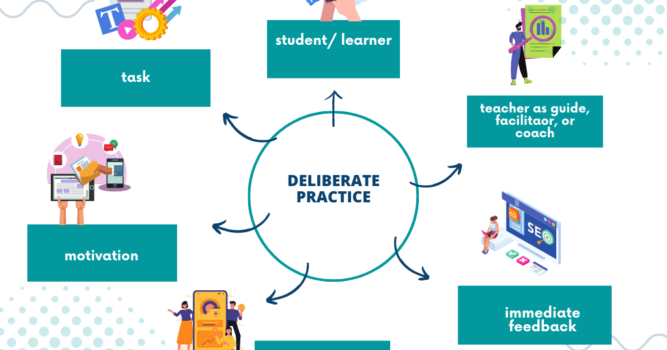
How might a language teacher create deliberate practice activities? Planning is at the centre of these types of activities. Teachers should also consider how they will scaffold students, enabling them to enter the activities at a level they feel comfortable and capable in, while guiding them to go beyond their current level of ability. Scheduling intentional activities at regular intervals so that students have multiple opportunities to practice and improve. Regular feedback to students during the activity so they understand what they are doing well and how they might go beyond their current ability. A logical next step to feedback is to discern whether feedback should be formative or summative. The intention of the practice and the amount of practice students have had will help with determining this. Motivation is a common factor in student improvement and one a teacher needs to be aware of. Students must be willing to participate and to work hard at this deliberate practice.

The role of the teacher in deliberate practice is one of coach or facilitator. Teachers set the scene (activity). Deliberate practice is learner-centred and therefore the learner takes on the responsibility for their learning and their improvement. Small groups enable the teacher to circulate and give feedback in the moment.

Different from the rote memorization of years past, deliberate practice offers learners multiple opportunities to practice with effort and concentration while receiving in-the-moment feedback from the teacher who acts as a guide or coach. Setting classroom activities and schedules to include such practice will enable learners to continually improve their level of language ability.

Here are some other resources on deliberate practice:

Altuwairesh, N. (2017). Deliberate Practice in Second Language Learning: A Concept whose Time has Come. International Journal of Language and Linguistics, 4, 111-115.

Baron, R. & Henry, R. (2010). How entrepreneurs acquire the capacity to excel: insights from research on expert performance. Strategic Entrepreneurship Journal, 4, 49-65.

Eliason, N. (2017, July 3). How to use Deliberate Practice to reach the Top 1% of Your Field. Website. https://www.nateliason.com/blog/deliberate-practice

Ericsson, K. (2006). The influence of experience and deliberate practice on the development of superior expert performance. Psychological Review, 100, 363-406.

Lawless, L. (2023). Deliberate French Practice. Website. https://progress.lawlessfrench.com/learn/deliberate-practice?utm_source=mailpoet&utm_medium=email&utm_campaign=lawless-french-deliberate-practice-elisions-leurrer-mot-du-jour-3972

Getting connected

Getting connected


Looking for a community of French teachers with whom you can share ideas, ask questions, and share resources?

Join the FRENCH TEACHER NETWORK!

Once a month, French teachers from across British Columbia meet via Zoom to discuss professional development opportunities, best practices, to share resources, and exchange ideas.

If you are interested in being part of this group, please email vanessa@ouifrenchteachers.com. The Zoom link will be sent to you including links to Google agenda and meeting minute documents.

What’s the word? Vocabulary in the language classroom

What’s the word? Vocabulary in the language classroom


Vocabulary has always been one of those things about being a language teacher that I have struggled with. I see the need for vocabulary, however, I hated how I was taught it in school. The teacher would hand out a huge list of words, we were told what day a quiz for each section would take place and it was up to us to review and study for the quizzes. No matter what, I rarely succeeded on these tests, and yet, I could have detailed conversations using the vocabulary. So as a teacher, I do not like giving out the large lists or the vocab quizzes. I find I have flip flopped between the two spots on the pendulum. That changes now.

In their article Assessing Vocabulary in the Language Classroom, Coombe (2011) sheds light on some of the basic questions language teachers should ask when looking at how they are teaching and assessing vocabulary.

From what I have read, and continue to find on the internet on the topic of vocabulary assessment is that it is linked to assessment in general – whether in a language classroom or not. Additional questions I find myself asking as I plan out units and lessons include: What material is being covered in lessons? How are the in-class activities being completed? What age and level are the students? What is the purpose of the assessment – formative or summative? With some intentional thinking and planning these questions can be easily answered. Questions that may be a bit more difficult to answer quickly can include: How do I encourage my students to be motivated to learn the vocabulary? How do I encourage buy-in of my students during classroom activities? Am I wanting students to self-assess core competencies or am I wanting them to reflect on their learning and demonstration of a skill or curricular competency?

The questions that work as headers in the article are:

  • How should I test vocabulary?
  • Which kind of vocabulary should I test?
  • Which format(s) should I use?
  • How many itens should I include?
  • How important is context?
  • Are there any tools or resources that can help me?

This brings me to what does review and practice in the language lesson look like? I teach high school and while I am a student who makes lists and writes things over and over to remember, not all of my students learn like this. So I have come up with a few activities I have found useful for a variety of learning styles over the years.

  1. Have students fold an A4 unlined paper into 8. Unfold. In each square have students write a vocabulary word in this unit of study as well as draw the word as an image. If like me, students will have stick people in almost every box. Other, more artsy students may have mini masterpieces!
  2. Get active! Whether inside on a rainy day or outside when the first dry day arrives, getting students to complete small actions while making sentences using the vocabulary words – this includes using the word in context portion of learning vocabualary. This can be jumping jacks, hopscotch, hoola hooping, or skipping, even a type of Simon says game. Anything that gets students attaching an action to the words they are learning.
  3. Riddles. Even the simplest of riddles can be helpful to students as they practice and recall vocabulary words. I often will use riddles as an in-betweeen, before we get things started, or we have a few minutes left at the end of class activity. This can use current vocabuarly and previous vocabulary – another way of showing students that just because we learned vocabulary in a previous unit doesn’t mean we no longer use it in the current unit.
  4. Let’s talk about it! I regularly have students start classes with partner discussions in which they are asked to get out their vocabulary sheets, and use as many of the words as possible in their conversations. The focus in these conversations is vocabulary first, grammar second, and so if I overhear students making some grammar errors, I tend to overlook them and rather focus more on creating a safe space for students to practice using vocabulary. There are other times in the lesson when grammar, pronunciation, or other language concepts are the focus and therefore mentioned.

As usual, I am by no means an expert on assessment or vocabulary. What I am convinced of is that the days of assessing a student’s ability to memorize words or verb conjugations should be things of the past. Do students need to broaden their vocabulary? Yes. Do students need to know how to conjugate verbs to communicate effectively? Yes. But memorizing and fervently writing them on a paper before they are forgotten is not, in my opinion, a demonstration of the skill of communicating in an additional language.

Resources on this topic:

Brown, J. D. (2005). Testing in the Language Programs: A comprehensive guide to English language assessment. McGraw-Hill.

Coombe, C. (2011) Assessing Vocabulary in the Language Classroom.

Actualités pour les jeunes

Actualités pour les jeunes


Are you looking for video clips that connect students with current events, see things from their perspective, and help them do so in French? Well, CBC’s webzine MAJ is a great resource!

There are a number of topics covered here and it is easy to change the speed of the audio, hear different accents to raise your students’ awareness of dialects and accents, and the videos are wonderful conversation starters for in class discussions.

In my classes we have used some of the environment videos as a way of introducing a topic, starting a unit, start off brainstorming, sharing ideas and guiding us to other topics that might be related.

Students have been able to listen to accents that are different from mine, but also hear a few that have similarities. This has led to conversations and more awareness to the variety of accents in Canada and abroad.

The fact that videos can be slowed down or played at normal speed has been helpful for students of all abilities, and then the URL is easy to post on our school online ports to enable students to access is outside of school.

ACSI Teacher Conference 2022

ACSI Teacher Conference 2022


Friday, October 7 marked the ACSI Teacher Conference 2022 in Surrey, British Columbia, Canada.

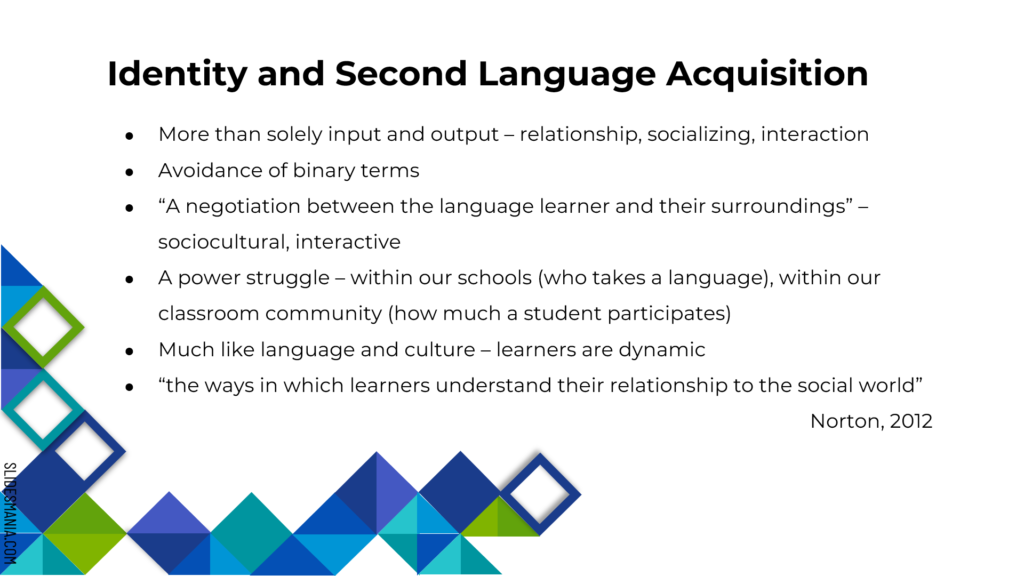
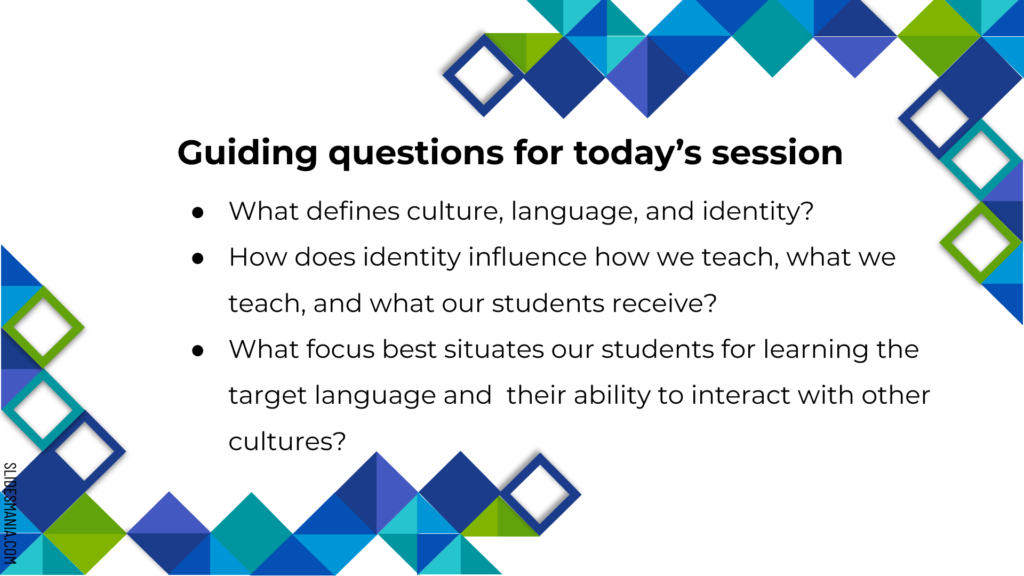
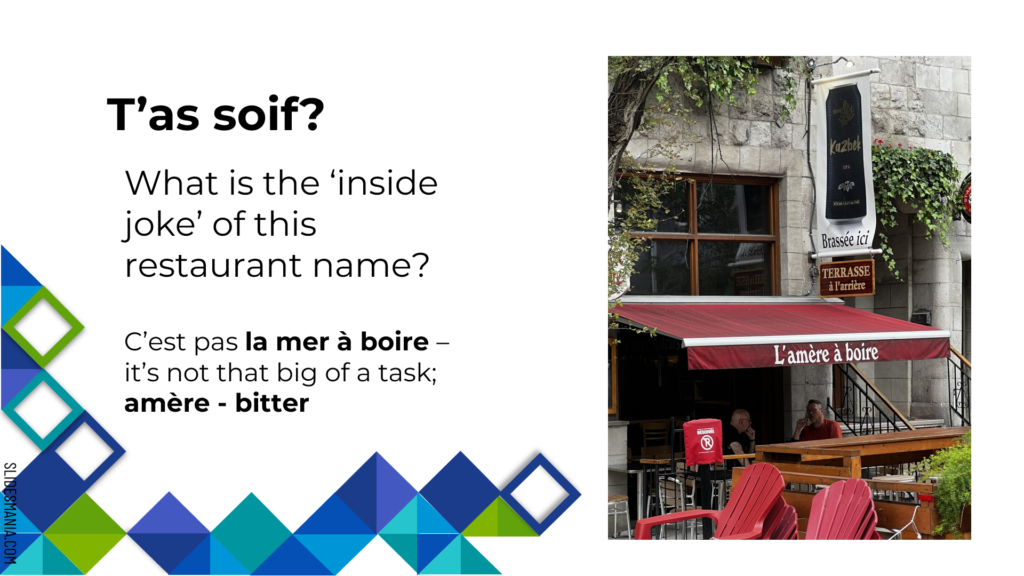
This was an opportunity for me to share with fellow educators the research I have been doing over the last 2.5 years as I have studied culture, identity, and language acquisition. The goals for the session were to share the researchers I have been reading, the theories that are being discussed in our field, and to give some examples of how we can incorporate these into our classrooms so that we can go beyond grammar and vocabulary to include the vast culture of the Francophone world, as well as prepare our students for a plurilingual and pluracultural world.

The 2022-2023 school year is just taking off! Lesson plans and unit goals to be uploaded in the coming months.

Weaving culture & allyship (part 1)

Weaving culture & allyship (part 1)

Flipgrid is now Flip – and it has a blog! In its May 23 blog post Ways to be a better ally plus resources that help build effective allyship skills, Flip has presented a helpful starting point for creating a space in your classroom where people feel safe, valued, and heard.

I was recently in a course where we were told we are not the saviors. That has stuck with me. It’s not up to me to be the voice that creates change, but I can use my voice, use my privilege, to create a space for authentic voices to be heard.

As I have been thinking of how to do this, I keep coming back to resources. The books, podcasts, websites, videos and posters I choose to present to my classes can and do help in the creation of this space. So, I need to choose them well.

This summer I have worked to create a resource library of items I can use in my efforts to be a better ally both in my classroom and out. I fully notice that the resources in this list are specific to First Peoples. It is such as I am presently decolonizing my courses, aligning them with current curriculum. As I use them this year, I will post free resources in the form of lesson plans that you can use in your classrooms as they fit your curriculum.

Here’s the list (so far).

BOOKS

When we were alone by David A. Robertson and Julie Flett

  • Debout comme un grand cèdre by Nicola I. Campbell
  • Si je disparais by Brianna Jonnie with Nahanni Shingoose
  • Why Indigenous literatures matter by Daniel Heath Justice
  • One story, one song by Richard Wagamese
  • Stolen words by Melanie Florence
  • Jingle Dancer by Cynthia Leitich Smith
  • I am not a number by Jenny Kay Dupuis and Kathy Kacer
  • A day with Yayah by Nicola I Campbell
  • La femme venue du ciel, myth wendat de la création by Huwennuwanenhs Louis-Karl Picard-Sioui
  • Shin-chi’s canoe by Nicola I. Campbell
  • When I was eight by Christy Jordan-Fenton and Margaret Pokiak-Fenton
  • Not my girl by Christy Jordan-Fenton and Margaret Pokiak-Fenton
  • Eagle soaring by Roy Henry Vickers and Robert Budd

Coming soon! The secret pocket by Peggy Janicki 

WEBSITES

The writing on the wall – murals with messages in Montréal

The writing on the wall – murals with messages in Montréal


I’m currently in Montréal, Québec for three weeks as I complete a course related to my M.Ed.  Besides meeting my cohort, who I have been learning with for 2 years now via Zoom, I have really enjoyed walking around and discovering the city.

As I walk, I pay attention to how the shop windows are dressed up or down, the way slogans are written, I pay attention to what people around me are saying and how they are saying it (example “ouais!”). I also pay attention to graffiti and murals. To be honest between doorways, bees, and streets, I likely take as many photos of painted walls.

What I’ve noticed in Montréal is there is a strong creative vibe, there is also a vibe that is calling out for justice. Specifically speaking, I have noticed a few murals that cry out the injustice experienced by the Indigenous women and girls in Canada.

This, like many other topics that are woven into the history of Canada, is raw, and is difficult. A question teachers may have is how can we present this topic to our students in a way that is respectful, that brings them into the conversation, and also age appropriate (as some of you may teach younger students).

As a high school teacher, I have been talking about May 5 and the Missing and Murdered Indigenous Women and Girls for years now. I can do that. They have the capacity and usually are mature enough to recognize this is a serious topic and one that deserves respect. Primary teachers should take into consideration the age of your students and how you would approach it. However, I don’t believe it means it’s a topic that can’t be discussed with young students. Like with the topic of residential schools, it should be approached with care.

For May 5, I usually hang red dresses around my classroom, this is a change to the class environment students notice right away and so they begin to have questions and chat amongst themselves about what it might be fore. I can start conversations in French with them with questions such as “Qu’est-ce qu’il y a de different dans notre salle de classe?” “Pourquoi pensez-vous que les robes rouges sont utilisées?”

This week in my course we discussed the different ways of responding to something, like in this case an idea or an experience. These are physically, spiritually, emotionally, intellectually. You can ask your students, « Quand vous êtes entrés dans la classe, et vous avez vus les robes, qu’est-ce que vous avez senti? Avez-vous eu une réaction émotive? Avez-vous eu une réaction physique? Voulez-vous la décrire pour nous? » And here is the opportunity for you to help students find the words in French for the answers they are giving.  They can use English words as they need, and you can help them to fill in the blanks with the French words. Here the students are thinking of a topic that is complex and complicated, using the French they know and hearing and seeing you model the French they are grasping for in their answers.

I can’t wait to show these photos to my classes and ask them if they have noticed such murals in our community. Think of the conversations we can have on whether they feel this is an important topic to be presented on a mural, perhaps there are other ways they think would be more effective. I can’t wait to open the space for the students to think about this topic, the impact it may have on our own community, and what they can do to advocate for this topic. Students will be able to work together, practice their French together and with the teacher circulating they can be helped to fill in the gaps with the French they are grasping for.

To learn more about Murdered and Missing Indigenous Women and Girls:

Native Women’s Winderness

The inquiry into MMIW

Moosehide campaign bringing awareness


Special Edition

Special Edition


Interview on DissectEd with Dr. Michaela Keegan Jedele

This week I am thrilled to be the guest of Dr. Michaela Keegan Jedele on her podcast DissectEd.

Michaela is currently doing a series speaking with teachers who find joy in teaching especially taking into account, and in spite of, the world events of the past few years.

I came across Michaela’s TikTok account shortly after one of my students said “Mrs. Drew, you need to be on TikTok”. From my first silly videos with students my followers have grown. More importantly, my teacher connections grew. I have seen what other teachers do in their classrooms. I’ve seen things I look forward to implementing next year and things that aren’t my style. I try to post messages of funny community building things that happen with my students (drinking corn milk for example, or tagging one of my favourite French Canadian singers so my students didn’t have to do a grammar test), and always want to encourage other teachers in their teaching practice.

Like Michaela, I have also seen and heard the struggles educators across North America are facing, the investments they make into their teaching and students, and the despair some have that have led to them leaving the profession. I respect teachers no matter whether they decide to stay or change directions.

Michaela reached out to me saying she enjoys my content and hoped I would agree to an interview. I was starstruck! She is someone I follow on TikTok! And she was reaching out to me! We each have stories, we all are on journeys, we all have something to contribute to the conversation about education, community, and growth. I am so honoured I was asked to contribute to her podcast.

Michaela is presenting a free summer seminar, “Self Taught: Teach the year you want”. It takes place online, with three evening sessions, starting July 14. The keynote speaker will be Daryl Williams (@mypursuitofexcellence – TikTok). You can easily register on her website. See you there!

https://www.drkeeganjedele.com

DissectEd podcast: https://www.drkeeganjedele.com/podcasts/dissected

TikTok: drkeeganjedele

Instagram: michaela_keegan

Une communauté de locateurs de français – A community of French speakers

Une communauté de locateurs de français – A community of French speakers


English follows the French.

Comment avez-vous appris le français? Est-ce que c’est un sujet que vous aimez? Est-ce que c’est complètement nouveau pour vous? Pas de soucis!

Même si je faisais des fautes quand je parlais français ou des erreurs quand je l’écrirais, j’adore la langue française et souvent, j’ai le nez dans un livre ou manuel de grammaire.  Je suis chanceuse que j’ai des ami·e∙s qui adorent le français aussi et nous parlions souvent, des fois pendant des heures, de la grammaire.

Mais comment améliorer votre niveau de français si, comme on dit en anglais, « French grammar isn’t my thing »? Tournez-vous à une communauté d’ami·e∙s, collègues, ou copains/copines!

Le but de parler en français n’est pas d’avoir la grammaire parfaite. Selon moi, c’est de communiquer des idées et d’agrandir mes compétences de grammaire et de vocabulaire. J’ai trouvé que quand je parle avec d’autres en français, j’apprends beaucoup – et en particulier quand je faisais des fautes! De plus, en parlant avec des locuteurs natifs/locutrices natives j’apprends des mots et des phrases spécifiques, comme des phrases idiomatiques par exemple.

Mais quoi faire quand vous ne trouvez pas une communauté française? Vous avez toujours moi et cette communauté! J’ai hâte de parler avec des nouveaux amis/nouvelles amies et de partager des idées avec des enseignant∙e∙s. Envoyez-moi un courriel à vanessa@ouifrenchteachers.com et nous pouvons nous rencontrer sur Zoom ou mieux encore, en vrai! J’ai des ressources que je pourrais partager et nous pouvons travailler ensembles sur d’autres projets pour nos élèves. Un de mes buts pour ce site web est d’agrandir ma communauté d’enseignant∙e∙s de français et de partager les ressources que j’ai ou que je trouve.

Here’s the English.

How did you learn French? Is it a subject you like? Is it completely new to you? No worries!

Even if/when I make mistakes when I speak or errors when I write it, I love the French language and I often have my nose in a French grammar book or textbook. I am fortunate enough to have friends who love French as well and we often spend hours just talking about French grammar.

But how does one improve their level of French, if like they say in English, “French grammar isn’t my thing”? Turn to a community of friends or colleagues.

The goal of speaking French is not to have perfect grammar.  In my opinion, the goal is to communicate ideas and deepen and widen my grammar and vocabulary competencies. I find that when I speak with others in French, I learn a lot – and in particular I learn specific words and phrases, such as idiomatic phrases.

But what can one do if there isn’t a community that speaks French available? You can turn to me and this community! I look forward to speaking with new friends and sharing ideas with other teachers.  Send me an email at vanessa@ouifrenchteachers.com and we can meet on Zoom, or better yet face to face! I have teaching resources that I can share (I’m happy to actually) and we can work on new projects together.  One of the goals of this website is to broaden my community of French teachers and to share resources that I have or that I find.

À plus! Vanessa